PUBLISHED ON 17 FEBRUARY 2016
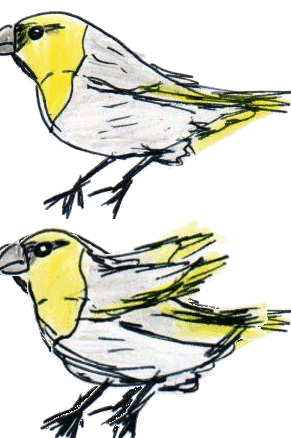
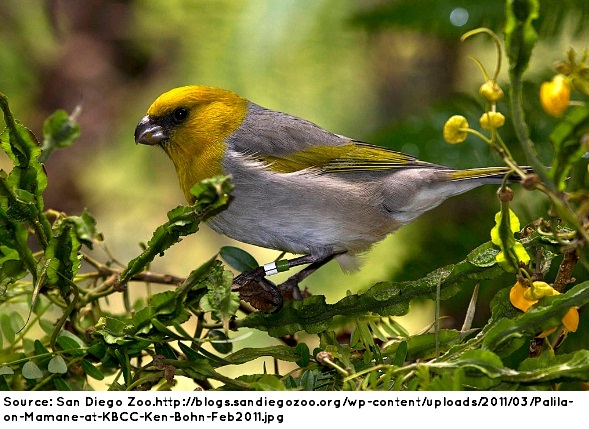
My ancestors had a wonderful life. The forests were filled with Mamane trees and the Palila would fly through them happily. They had plenty of the nourishing mamane seeds that are so crucial to our diets. You see, we Palila mostly feed on the unripe seeds of the Sophora chrysophylla (mamane) tree. While we occasionally eat caterpillars, insects, naio fruit, and moth larvae that also enjoy mamane, the seeds and flowers of the mamane are the staples of our diet. We also move around in respect to mamane seed availability. The mamane has always been very important to us, but humans are just now catching on.
A recent study on our habitat and food preferences found that we spent the majority of our time in mamane trees and that we are basically extremely dependent on them. 90% of our food comes from these mamane trees. These silly humans also finally found that we have a limited ability to pursue other food sources. A little too late, right?!
Our habitat is a huge part of who we are. Right now, we only live on the slopes of Mauna Kea. It wasn't always like this, but I'll get to that later. We make nests made of bark, roots, stems, and grassses in the branches of our sacred mamane trees. We inhabit subalpine forests at altitudes of between 2,000 and 3,000 meters. We are very selective when it comes to our habitats because we only thrive in specific native ecosystems that contain our great mamane trees. The great mamane is our friend that supports us. But, unfortunately, humans have done so much to hurt our dear friend.
The habitat of my kin has changed drastically over the last couple centuries. We inhabited forests on Oahu and Kauai in addition to Hawaii Island. On Hawaii Island, itself, we had inhabited more than just Mauna Kea. We were the superstars of the forest in Hualalai and Mauna Loa as well. Unfortunately, our habitats have been severely over browsed by sheep and goats. Our nests have been preyed on by introduced rats, feral cats, and short eared owls. The feral pigs are threatening the regrowth of our beautiful mamane trees; introduced grasses do the same and additionally increase the risk of fire. This all has been devastating for our populations.
The Palila had once been abundant across Big Island. This was at the beginning of the 20th century. However, we are now only found on the slopes of Mauna Kea; our last little sliver of the glorious land we had once covered. We occupy only 10% of our original range. The scariest part is that our populations have dwindled to an estimated 3,000 individuals. As the humans hurt our friend and our forests, they were also hurting us.
Some humans have tried to help us in our plight. They have tried to remove the sheep and goats from the Mauna Kea slopes so that our mamane can grow more abundant, but that hasn't exactly helped enough. A more useful method was human intervention by captive breeding. They created a safe environment for Palila to breed and then they would translocate more of us into the forest. I am a little spoiled, for I was once part of that program. However, I was released into the wild and managed to learn from my elders about the history of my kind. I learned about the atrocities committed against us and, I was honestly appalled.
There are other ways that humans have been helping us out. Some agencies have started programs to remove cats and rats. The, they have worked on replanting the forest so that birdies like us can stand a chance. Despite all of these efforts, the future of my species is unknown, for we are still critically endangered. CRITICALLY endangered, as in, it's critical that someone does something NOW! Please help the Palila for we are beautiful creatures and we don't deserve to become extinct like so many other beautiful creatures on this planet.
---------